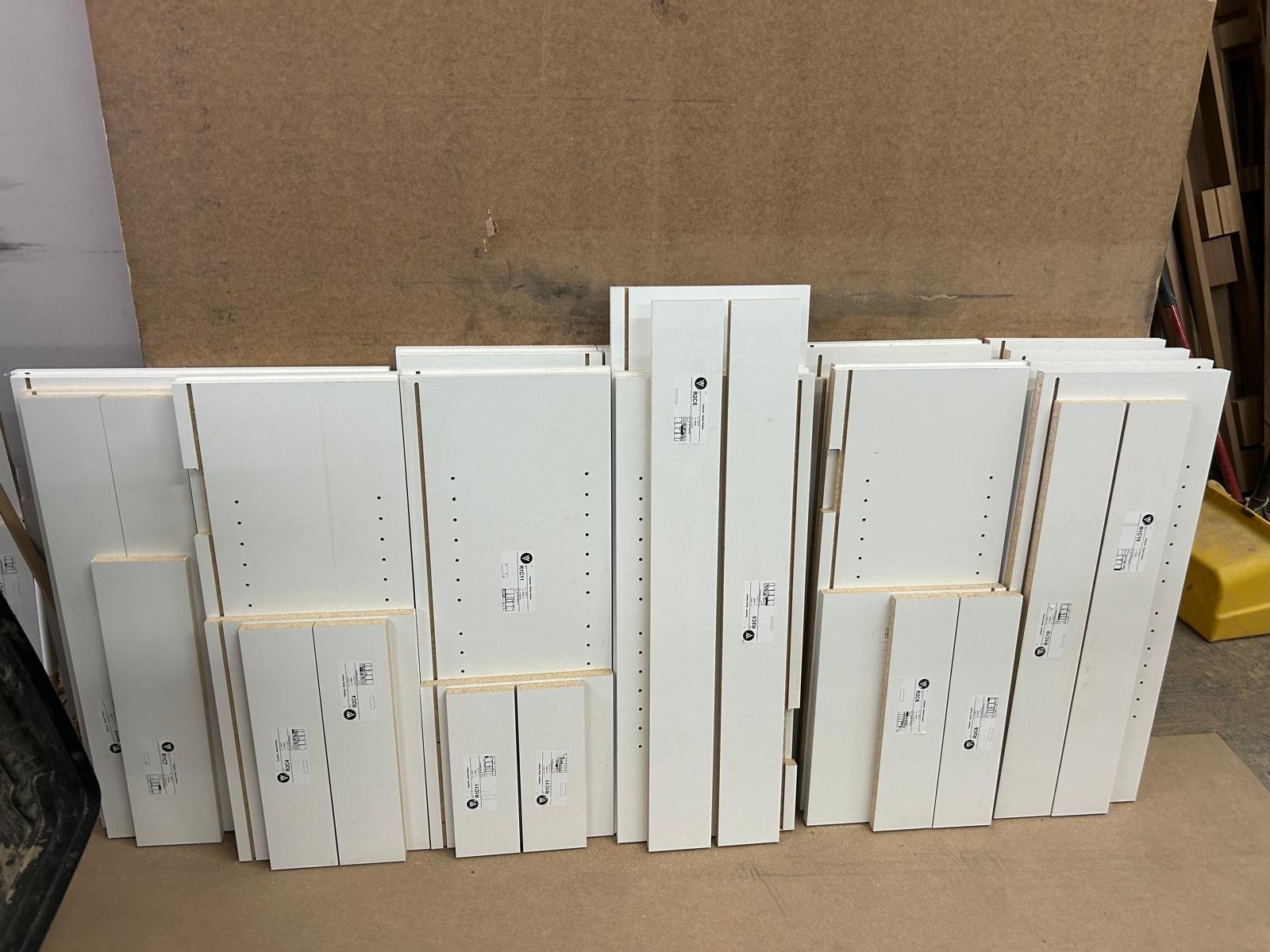
You measure. We manufacture. That is the whole idea, and the easiest way to see how it works is to follow one kitchen through every step.
The example below is illustrative, not a single client’s job – but it is built from the situations we see all the time in South Florida kitchens, and every step is the same one your project goes through. The contractor or homeowner handles measurements and installation. We make the parts.
The job before the parts
Picture a galley-and-island kitchen in a 1990s home in Broward. The original boxes are sagging, and the owner wants more usable storage without paying for a fully managed custom build. The scope: base cabinets, wall cabinets, one full-height pantry, and an island with a seating overhang. White slab fronts, cabinet-grade boxes, soft-close hardware.
The catch is the room itself. One corner is out of square over the length of the run, and the ceiling drops along the window wall. That is exactly the situation where standard stock boxes get expensive: every filler, every scribed panel and every awkward corner becomes a problem to solve on site. The better move is to build to the room instead of fighting it – and that decision drives everything that follows.
Step one: measurements and the cut list
The build starts with a tape measure, a level and a notebook – not a showroom visit.
Walk the room in sections, noting walls, corners, the window opening, and the plumbing and electrical locations. Measure out-of-square corners at both the front and the back. Record the ceiling drop so the wall cabinets can sit level without a gap at one end.
Then the cut list. This is the document that matters: a plain spreadsheet or written list with a line for every part – box panels, shelves, fronts, toe kicks, fillers and end panels – each with its finished width, depth, thickness and quantity. Material is specified per line: melamine/TFL for boxes and fronts, or cabinet-grade plywood where you want it. If you have never built one, our cut list method walks through it step by step.
Two rules save time here:
- Measure twice and write it down once. A cut list is only as good as the numbers on it.
- Flag the problem areas in the list. Out-of-square corners and level changes are not surprises if they are already built into the part sizes.
Step two: manufacturing the parts
The cut list arrives, and the shop takes over.
Panels are cut to size on our CNC router from the sheet stock specified on the list. Holes for shelf pins, hinge cups and drawer slides are machined in the same program as the cut, so every part of the same type comes out identical. Then the edges are banded, and every part is labeled so nothing gets mixed up between cabinets or between jobs.
That matters more than it sounds. A contractor installing a full kitchen wants to open a stack and start fastening, not drill hundreds of holes by hand. Machined parts turn installation into assembly.
The end panels and the window-wall filler are cut to the out-of-square dimensions recorded on the cut list, so the fitting work is done at the saw instead of on site.
Step three: kitting and delivery
Ready to assemble should mean ready – not a pallet of loose parts to sort through.
Parts are packed by cabinet rather than by part type. That is the small detail contractors notice first: instead of hunting through a pallet for the sides of cabinet seven, each stack is one cabinet, with its label on every piece.
Delivery goes out in install order – bases first, then wall cabinets, then the island – so the parts you need first are the parts on top. Local pickup is also available if you would rather collect the kit yourself.
Step four: installation
Installation is where the decision to build to the room pays off. This part is yours or your installer’s – here is what it looks like with parts cut to the real measurements.
Base boxes go in level, shimmed at the low spots, fastened to studs and to each other. The island’s seating overhang goes on with proper support brackets – a step people skip and then regret when someone leans on the counter. Wall cabinets hang level across the window wall because the closure panels were already cut to cover the ceiling drop.
Doors and drawers go on cabinet by cabinet, following the labels. The out-of-square corner meets a filler that was cut to fit it, so there is far less trimming and fewer trips back to the saw than on a stock-box job.
What building to the room changes
- Fit: Fillers and end panels are sized to the walls you actually have, so the problem corners are solved before the parts arrive.
- Installation: Machined, labeled parts packed by cabinet mean the installer spends the day assembling, not sorting and drilling.
- Waste: Material is cut to the list rather than cut and cut again on site.
- Control: You choose the material and the hardware instead of inheriting a catalog package.
That is the point of buying parts from a local shop that makes them: you keep control of materials and installation, and you deal directly with the people who cut your parts. If you are still weighing this against a catalog kit or a fully custom build, see RTA cabinet kits vs. custom-built cabinets.
What this process teaches
Three things carry a job like this.
First, the cut list is the project. Good numbers in mean good parts out. Sloppy numbers cost more than any material upgrade.
Second, build to the room. Out-of-square corners and ceiling changes are common, especially in older homes. Parts cut to the real measurements go in cleanly; standard boxes get forced.
Third, machining and labeling are not frills. They are the difference between assembling cabinets and rebuilding them on site.
Your project, same process
Send your measurements, a sketch or a cut list. We cut, machine, edge band and label the parts in our own South Florida shop – as cut-to-size panels, machined components, or a complete custom RTA cabinet kit that is ready to assemble. Trade partners can see how we work on our For Trade page. Full design-to-installation service is also available, for a deliberately small number of projects.
You bring the project. We make the parts.
You measure. We manufacture. Send your cut list on WhatsApp or call (754) 308-9135.