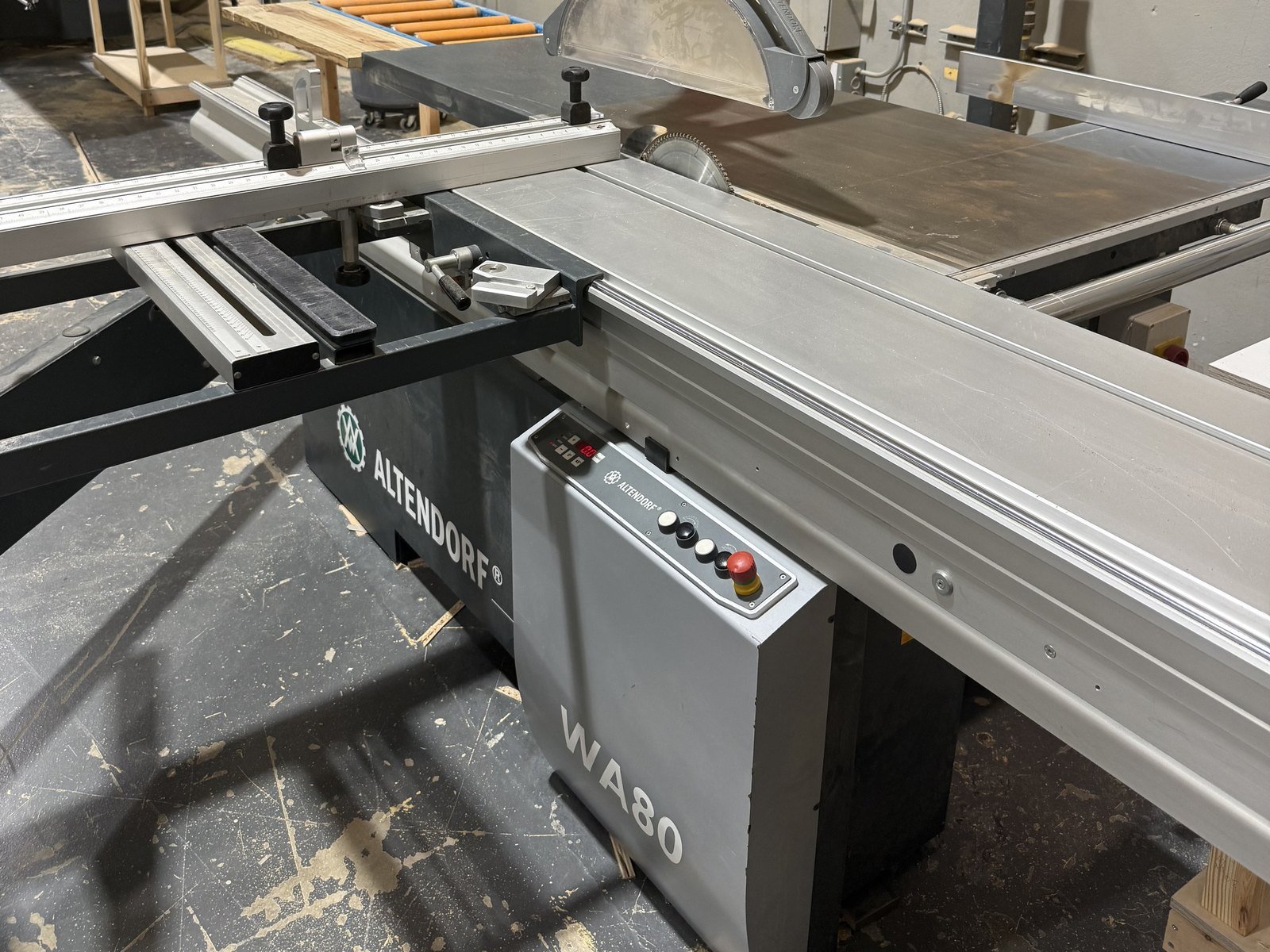
Most people assume custom cabinets come one way: a shop designs the job, builds it and installs it. From a shop that runs its own production line, there are actually three ways to buy. You can order cutting only, cut plus machining, or a complete custom RTA kit. All three come out of the same panel saw, CNC router and edgebanders. What changes is how much of the project you bring, and how much of it we work out for you.
This guide explains what each option includes, who it tends to fit, and what to send so the quote is right the first time. It applies to kitchens, closets, vanities, TV units and built-ins anywhere in Miami-Dade, Broward and Palm Beach.
The three options at a glance
| Option | You bring | We do | You receive | Typical fit |
|---|---|---|---|---|
| 1. Cutting only | A finished cut list | Cut panels to size on the panel saw and CNC | Panels at the sizes on your list | Cabinet shops, pros with their own drawings |
| 2. Cut + machining | A cut list or shop drawings, plus your hardware specification | Cutting, CNC machining, drilling, edge banding, part labels | Finished parts, ready to assemble | Contractors, handymen, designers’ projects |
| 3. Complete custom RTA kit | Measurements, photos, a sketch or an idea | Design, detailing, cutting, machining, edge banding, labeling and packing by cabinet | A full flat-pack cabinet kit, labeled by cabinet | DIY homeowners, anyone starting from the room |
Every option is quoted individually, because panel count, material, machining and hardware preparation change from job to job. Pricing comes back on WhatsApp for the option you choose, and there is no production commitment to send a project for review.
Option 1: Cutting only
This is the simplest order. You already have a cut list, with every part sized and counted, and you need the panels cut accurately. We cut them to size and hand them back. Machining, drilling and edge banding are not part of this option; if you want them, see option 2.
Cutting only fits a cabinet shop that is short on saw time, a contractor who details their own cabinets, or a serious DIY builder who has already worked through the measurements. In all three cases the cut list is the contract between us, so it has to be complete.
A usable cut list states the units, the material for each part, the finished size of every panel, the quantity, and the grain direction where it matters. If you have not built one before, the cut list method walks through it from room measurements to a part-by-part list.
Option 2: Cut + machining
Here the panels come back as parts, not blanks. On top of cutting, this option adds CNC machining, drilling for hinges, drawer slides and shelf pins, edge banding on our own edgebanders, and a label on every part. The drilling pattern is programmed together with the cut, so parts of the same type leave the shop identical.
Because the holes are made for specific hardware, this option needs your hardware specification: which hinges, which slides, which shelf-pin spacing. We bore to that specification. Hardware is specified per project, and we do not guess it for you. If you are still choosing, tell us what the cabinet has to do and we will help you narrow it down.
Cut plus machining is the usual choice for general contractors and handymen who assemble on site, and for interior designers and architects whose project already has drawings. The parts arrive ready to assemble, with the work that is slow and error-prone on a jobsite, such as hinge boring and edge banding, already done in the shop.
Before you release the order, confirm the drawings and the hardware details line up. Cabinet shop drawings: what to confirm before production is the checklist we use for that review.
Option 3: Complete custom RTA kit
If you are starting from the room rather than from a drawing, this is the option. You send measurements, photos of the space, a hand sketch or inspiration pictures. We review what you send, work out the dimensions, material and construction, and turn it into a complete flat-pack cabinet kit made to your measurements.
What arrives is a set of finished parts, not an assembled cabinet. The kit is not pre-assembled: you or your installer put it together on site. To make that straightforward, the shop prepares the kit in a particular way:
- Drilled in the same program as the cut. Shelf-pin holes, hinge cups and slide holes are machined on the CNC together with the cutting, so parts of the same type match.
- Packed by cabinet. Each stack is one cabinet, not a pile of all the sides or all the shelves.
- Delivered in assembly order. Base cabinets first, then wall cabinets, then the island.
A complete kit suits DIY homeowners, and anyone who would rather hand over the design work and keep the assembly. For a full walk-through of one kitchen, from measurements to the installed result, read how a custom RTA kit build works. If you are still weighing a kit against a fully custom build, RTA cabinet kits vs. custom-built cabinets compares the two side by side.
How to choose
Three questions usually settle it.
- What do you have in hand? A finished cut list points to option 1. Drawings or a cut list plus a hardware specification point to option 2. Measurements and an idea point to option 3.
- Who assembles? If a cabinet shop or a crew with its own detailing is building the job, options 1 and 2 keep that work where it already lives. If you are assembling yourself, option 3 gives you a kit designed to be assembled by the person who ordered it.
- How much of the thinking do you want to keep? Options 1 and 2 keep design decisions on your side. Option 3 moves them to our side, and you approve the result before anything is cut.
You can also mix options on the same job. A contractor might order a complete kit for a kitchen and cutting only for the pantry shelving, because the shelving is simple and the crew prefers to band it on site.
What every option has in common
Whichever you choose, the parts are made in our own South Florida shop, on our own panel saw, CNC router and edgebanders. The material choices are the same across the three: melamine/TFL for closets, drawer boxes and cabinet interiors, or cabinet-grade plywood when the project calls for plywood construction. Machined parts and complete kits are organized and labeled by cabinet, while cutting-only orders come back as panels at the sizes on your list. Every order is ready for local pickup at the shop, or delivered within South Florida.
And if a project needs someone to own it from design to installation, that service is also available, for a deliberately small number of projects.
What to send
- Cutting only: the cut list, with units, material, finished sizes, quantities and grain direction.
- Cut + machining: the cut list or shop drawings, plus the hardware specification and which edges get banded.
- Complete custom RTA kit: room measurements, photos of the space, a sketch if you have one, and a note on how the cabinets will be used.
Send it on WhatsApp and we reply with the next step and a quote for the option you need. Contractors, designers and cabinet shops can also start from the trade page; homeowners will find the full picture on custom RTA cabinets.
You measure. We manufacture. Message us on WhatsApp, call (754) 308-9135, or email contact@m11designgroup.com.